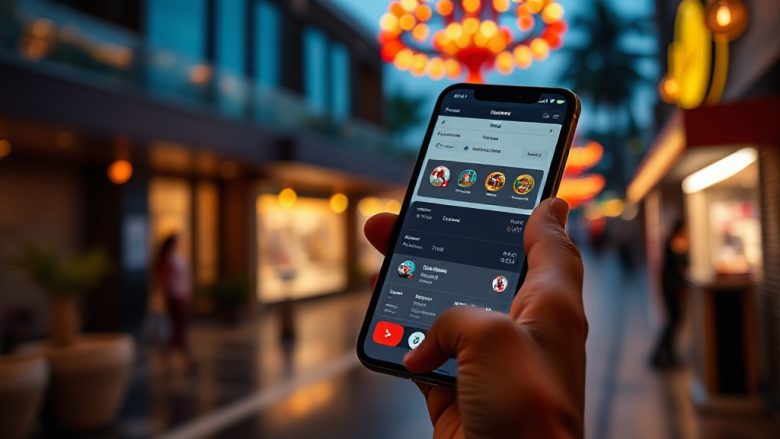
From Street Corner to Screen: tk999 in a Regional Shift
The betting counter that once anchored a street corner — a shuttered kiosk, a handwritten odds board, a queue of men checking football scores — has largely vanished from the visible life of South Asian cities. What replaced it is not another shop but a rectangle of glass in the palm. The shift from pavement to pocket is the quiet revolution that platforms like tk999 occupy, and understanding that shift is the only way to understand what the brand actually is.
tk999 is an online betting and gaming platform built for Bangladeshi users, offering registration and a downloadable mobile app. It is not a physical venue, not a ticket, and not a number to call. It is a screen-based service, and its meaning sits inside a much larger regional story about where wagering happens and who controls it.
The vanishing counter and the rise of the handheld venue
For most of the twentieth century, betting in South Asia was a place you went to. It had a door, a proprietor, a set of unwritten rules about who could enter and when. The counter was social infrastructure as much as commerce: it collected gossip, settled disputes, and turned a football match into a shared event. Its disappearance was not sudden. It was a slow migration, driven by regulation, by the spread of cheap smartphones, and by a generation that preferred to transact without being seen.
The first stage was the cybercafé, where a shared desktop became a temporary betting terminal. The second was the browser on a personal laptop. The third, and the one that matters now, is the app — a dedicated piece of software that lives on the phone and opens with a tap. tk999 belongs to this third stage. Its product is not a building but an interface, and its address is a URL rather than a street.
Why the physical venue lost its function
Three forces did the work. Regulation made storefront betting harder to operate openly. Mobile data became cheap enough that a phone could replace a queue. And trust migrated: once users could see balances, transaction histories, and withdrawal records on a screen, the proprietor’s word stopped being the only guarantee. The counter did not die because people stopped betting. It died because the phone did the same job with less friction and less exposure.
The consequence is that a platform’s reputation now rests on interface design, payment reliability, and app stability rather than on a familiar face behind a grill. That is a different kind of trust, and it is the kind that a modern betting brand must earn through repeated, verifiable transactions.
What tk999 actually is, and what it is not
The name invites misreading. It is not a ticket, not a token, and not an emergency number. In the context of the platform, tk999 is simply a brand name for an online betting and gaming service aimed at Bangladeshi users. The site describes itself as a trusted online betting platform, and its core offer is straightforward: registration, a downloadable app, and access to betting markets through a mobile interface.
This matters because the most common mistake newcomers make is to search for a physical location or a phone-based agent. There is no counter to visit. The entire relationship is digital, which means the onboarding step — creating an account — is the real front door. The app is the venue. The registration form is the entry gate.
The three components users actually encounter
- Registration: the account-creation step that establishes identity and opens access to the platform.
- The downloadable app: the mobile client that turns a phone into the betting interface.
- The betting and gaming surface: the markets and games themselves, presented through the app or site.
Everything else — payment methods, withdrawal timelines, verification requirements — sits underneath these three. A user’s experience is shaped far more by how smooth registration and the app are than by the breadth of the market list.
Four shifts that explain the move from pavement to pocket
The migration is easier to understand as four overlapping changes rather than a single event. Each one removed a reason to leave the house.
1. From shared space to private screen
The street-corner counter was public. Anyone could see who was betting and how much. The phone is private. This privacy is the single strongest driver of adoption in a region where visible gambling carries social cost. A user can register, deposit, and place a wager without a neighbour knowing. The trade-off is that the social accountability of the counter disappears, which places more weight on the platform’s own safeguards and on the user’s self-discipline.
2. From cash to digital balance
Cash at the counter was immediate and anonymous. A digital balance is traceable and requires a funding step. This is where many new users stumble: they expect the instant settlement of a physical transaction and are surprised by verification, processing windows, or payment-method limits. Understanding the funding and withdrawal flow before depositing is the difference between a smooth start and a frustrating one. The platform’s payment layer, not its odds, is often what determines whether a user stays.
3. From fixed hours to continuous access
A shop opens and closes. An app does not. Continuous access expands the number of moments in which a wager is possible — the commute, the lunch break, the late night — and that expansion is the core commercial logic of mobile betting. It is also the core risk. The absence of closing time removes a natural brake, and users who treat the app as an always-open venue are the ones most likely to overextend.
4. From local operator to distributed platform
The proprietor knew his customers. A platform knows its users through data: login patterns, deposit frequency, session length. This enables personalisation and faster support, but it also means the relationship is mediated by systems rather than people. For a Bangladeshi audience, the practical question is whether the platform’s support and verification processes feel responsive in local terms — language, payment rails, and turnaround time.
What the shift asks of users, and what it asks of the platform
The move from street to screen transfers responsibility. At the counter, the proprietor enforced limits, knew when a customer had had enough, and often extended informal credit. On a phone, the user is the operator. This is the least discussed consequence of the regional shift, and the one most worth dwelling on.
For users, the practical requirements are unglamorous: verify your account before you need to withdraw, understand the deposit and withdrawal methods available in Bangladesh, keep the app updated, and set a personal limit before the first wager rather than after the first loss. The convenience of a handheld venue is real, but it is convenience without a closing bell.
For the platform, the requirements are trust-related. A brand operating without a physical presence must compensate with clear terms, reliable payments, and responsive support. tk999’s positioning as a trusted platform is a claim that can only be validated transaction by transaction. In a market where users have many options and short patience, reliability is the product; the games are the content.
Common mistakes worth avoiding
- Skipping verification until withdrawal. Complete it at registration, not at the moment you need money.
- Assuming the app is optional. If you intend to use the service regularly, the downloadable app is the primary interface, not an accessory.
- Ignoring payment limits. Deposit and withdrawal caps differ by method; check them before funding.
- Treating continuous access as continuous play. The absence of closing hours is a feature of the medium, not an invitation.
None of these are exotic. They are the ordinary frictions of moving a cash-based habit onto a digital rail, and they appear in every market that has made the same transition.
Reading the shift through one platform
Seen from a distance, the story of South Asian betting is not a story about games. It is a story about infrastructure: cheap data, cheap handsets, digital payments, and a generation that finds a screen less intimidating than a storefront. tk999 is one expression of that infrastructure, built for a Bangladeshi audience and delivered through registration and an app rather than a door and a counter.
The street corner has not been erased so much as absorbed. The queue, the odds board, and the proprietor’s nod have been compressed into a login screen and a balance. What remains to be seen is whether the trust that the counter carried — the trust of a known face and a settled debt — can be rebuilt in a medium that has no face at all. That is the real question the regional shift leaves open, and every platform, including this one, is answering it one transaction at a time.