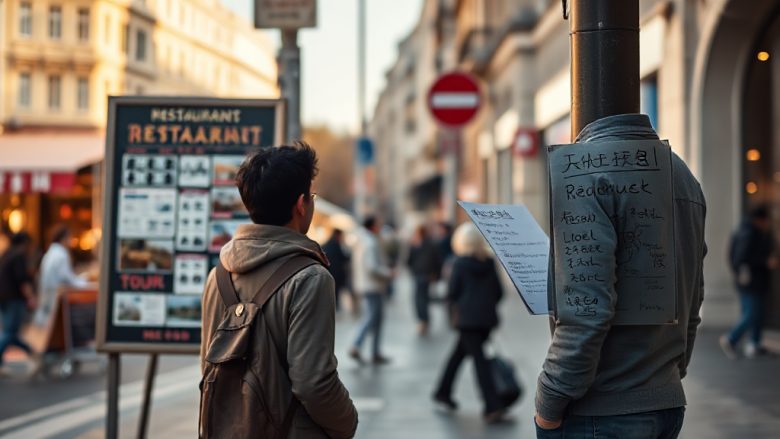
You sit down because the chairs are full and the awning is shady. Then the menu arrives: six languages, glossy photos, and not a single price next to the fish. That moment — before you order, before you pay, before you commit — is where learning how to avoid tourist traps when travelling actually pays off. Not in some grand strategy, but in a handful of small tests you can run in under five minutes, in any city, in any language.
I’ve eaten the mediocre €28 paella and paid for the “panoramic tour” that was mostly a bus idling in traffic. This is the repeatable system I use now, built from those mistakes.
Read the menu and the street before you sit down
The menu is the first honest document a restaurant gives you, and it tells you more than the food will. A menu with no prices is not charming; it’s a blank cheque. A menu translated into six languages usually means the kitchen is cooking for volume, not for locals. Photos of every dish, laminated and sun-faded, are another signal that the food is being assembled rather than cooked.
The single best test is proximity. Walk one block off the main square, one street back from the waterfront, and look at where people are eating. If the tables are full of people speaking the local language at lunchtime, that’s your answer. If every table is a tour group with identical plates, keep walking.
Prices matter too, but not in the way you’d expect. A restaurant charging 20% more than its neighbours isn’t automatically a trap — sometimes it’s just better. The trap is when the price is high and the menu is vague and the location is prime. Two of those three is a warning. All three is a decision you’ll regret.
One more practical habit: check whether there’s a cover charge or bread fee listed. In many countries it’s normal and legitimate, printed clearly at the bottom. When it appears on the bill but nowhere on the menu, that’s not local custom — that’s a test of whether you’ll argue.
Spot fake reviews and commission-driven tours
Reviews are useful, but only if you read them like a sceptic. A restaurant with 4.9 stars and 2,000 reviews, all posted within the same three weeks, is not a beloved institution. It’s a marketing campaign. Look for reviews that mention specific dishes, mention a return visit months later, or complain about something small and believable — a slow service night, a noisy table. Perfect scores with no friction are the least trustworthy thing on the internet.
Sort by newest and by lowest. The newest reviews tell you what the place is like this month. The lowest reviews tell you what goes wrong when it goes wrong, which is often the most useful information you’ll get. If the one-star reviews all describe the same problem — aggressive upselling, a hidden fee, a tour that skipped two promised stops — believe the pattern, not the average.
Tours deserve their own scrutiny because the economics are invisible to you. A hotel concierge, a hostel noticeboard, or a street tout recommending a specific operator may be earning a commission on every seat they fill. That doesn’t automatically make the tour bad, but it does mean the recommendation isn’t neutral. Ask two questions before booking: who actually runs the tour, and what exactly is included. If the answer to the first is vague — “our partner company” — you’re buying a resold ticket, often at a markup, often on a bus that collects passengers from four other hotels first.
The better alternative is usually to book directly with the operator, or to find a guide through a platform where the guide’s name, reviews, and cancellation policy are visible before you pay. Small-group walking tours run by a named individual tend to be better value than the big branded experiences, because the person leading it has a reputation to protect.
Handle crowded photo spots and overpriced “experiences”
The famous viewpoint at sunset is a trap not because it’s bad, but because everyone arrives at the same time and the experience collapses under its own popularity. You queue for a photo, you get jostled, and you leave with the same image ten thousand people posted this week.
The fix is timing, not avoidance. Go at 7am, or go in the middle of the afternoon when the light is flatter but the crowds have thinned. Go on a weekday rather than a weekend. Go in the off-season if you can. And if a spot is genuinely worth the crowd, accept the crowd and stop fighting it — arrive early, get your shot, and move on rather than standing there resenting the queue.
Then there’s the category of paid “experiences” that exist mainly to separate you from cash: the photo opportunity with a costumed performer who then demands payment, the “traditional” show that’s a 40-minute tourist performance with a drinks menu, the boat trip that’s mostly a floating gift shop. The test here is simple. Ask what you’ll actually see or do, in plain terms, and whether a local person would pay that price for it. If the answer is no, and the only people buying are visitors, you’ve found a trap.
Some of these are still worth doing. A cheesy show can be a genuinely fun evening. The point isn’t to avoid all touristy things — it’s to know when you’re paying for an experience and when you’re paying for a markup. Choose the former deliberately; don’t stumble into the latter.
Use a quick decision checklist on the ground
None of this requires research marathons. It requires a short set of questions you run in your head before you hand over money. Here’s the version I actually use, trimmed to what matters:
- Are prices printed clearly, before I sit or commit?
- Is anyone local eating, drinking, or queuing here — or only visitors?
- Do the reviews describe specific, believable experiences, or are they uniformly glowing and recent?
- Who runs this, and what exactly is included?
- Would a resident pay this price for this thing?
- Am I choosing this, or did someone steer me here for a reason I can’t see?
If two or more answers feel wrong, walk away. There’s always another option, and the cost of a bad meal or a wasted afternoon is rarely the money — it’s the time you don’t get back.
The truth is that avoiding tourist traps isn’t about being cynical. It’s about slowing down just enough to notice the signals that were there all along: the price-less menu, the commission-driven recommendation, the perfect review score, the crowd all arriving at once. Once you can see those signals, the whole trip gets calmer. You stop bracing for the rip-off and start actually looking around. And the best meals, the best walks, and the best afternoons tend to be the ones nobody was selling you in the first place — the ones one street back, at the wrong time of day, where the locals are already eating.